Showing posts with label Rodin. Show all posts

Sunday, 18 March 2012

Walter Barnett at 150


I missed Walter Barnett’s 150th birthday. He was born on 25 January 1862.

Walter who? H Walter Barnett. Australia’s first world-class portrait photographer. I was lucky enough to rediscover him and his fine work and thought Something Should Be Done about it. But what?

So on a trip to Sydney, I went to see my friend Leo Schofield, at that time director of the Sydney Festival. Leo knows everything worth knowing about the arts in Australia.

“What do you think of Walter Barnett’s work, Leo?” I asked as innocently as possible.

“Walter who?”

“You know, the Australian portrait photographer,” I replied.

“No. Don’t think I know of him,” said Leo.

Cue for me to lay out on Leo’s desk a dozen or so photocopies of Barnett portraits – the writer Robert Louis Stevenson, the great pianist Paderewski, Mark Twain, the “father” of Australia Sir Henry Parkes, artists Tom Roberts, Arthur Streeton and Charles Conder, Dame Nellie Melba, actress Sarah Bernhardt (above), sculptor Auguste Rodin and so on.

There was a pause.

“Will you curate an exhibition for the Festival?” asked Leo.

“Well yes. I’d be delighted to.”

That morning, Leo called Andrew Sayers, director of the recently-opened National Portrait Gallery in Canberra, and so Legends: The Art of Walter Barnett became an NPG project that ran in Sydney, Canberra and the Mornington Peninsula.

Overall it was visited by some 186,000 people.

Wednesday, 5 January 2011

Invictus and personal responsibility


It’s at this time that many of us make new commitments and plans for the coming year. I’ve no doubt that WE Henley’s poem, “Invictus”, helped me to retrieve and take responsibility for my own life and work in the late 1980s.

Up to that time, it seemed to me that I was owned lock, stock and barrel by whichever advertising agency employed me. Everything seemed so urgent and important at work that I sacrificed many other important aspects of life, not least family. And I didn’t realise then that the advertising business has a memory lasting something less than a nanosecond.

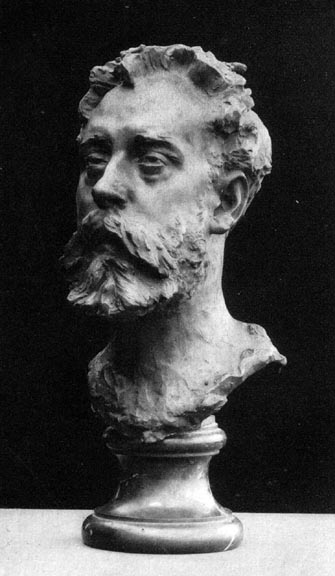
Henley (above, bust by Rodin) had a difficult, extremely painful childhood. He caught tuberculosis of the bone as a twelve year-old and his life was saved by the pioneering surgeon, Joseph Lister, at the Royal Infirmary in Edinburgh with the amputation of his leg at twenty-six in 1875. There he wrote the poem, convalescing in that hospital and also meeting Robert Louis Stevenson for the first time. (Henley was the inspiration behind the character Long John Silver in Stevenson’s Treasure Island.)

A century later, imprisoned on Robben Island, Nelson Mandela read the poem aloud to other inmates.

Out of the night that covers me,
Black as the Pit from pole to pole,
I thank whatever gods may be
For my unconquerable soul.

In the fell clutch of circumstance
I have not winced nor cried aloud.
Under the bludgeonings of chance
My head is bloody, but unbowed.

Beyond this place of wrath and tears
Looms but the Horror of the shade,
And yet the menace of the years
Finds, and shall find, me unafraid.

It matters not how strait the gate,
How charged with punishments the scroll.
I am the master of my fate:
I am the captain of my soul.


I wonder if it speaks to you?

Tuesday, 7 December 2010

Arts creative, science logical?

Throughout my childhood and so-called education, I had the notion that the arts were “creative” and science was “logical”. And I clung to this belief for a long time, only gradually coming to realise that some profound paradoxes were involved.

On the one hand, with the help of Karl Popper I came to understand that scientific advance comes from intuitive creative leaps (to be later explored through experimental research).

Yet most scientists (and lay people) still appear to believe that the process is the other way around, and that logical deductive thought is the driver of new knowledge. More than that, my experience is that too many scientists and engineers seem to have a belief that they are not creative beings at all.

On the other hand, most musicians and artists go through rigorous executant training that enables them to become highly skilled practitioners in their particular field. Most artists and musicians (and people generally) assume that their achievements are driven by creativity, whereas my sense is that they are usually driven by learned skills.

Put simply – science is primarily driven by creativity and the arts by skill.

Why have we come to believe that it’s the other way around? And what might be the implications for our education system?